Snake Case Converter Online - Free Text to snake_case Tool
Admin
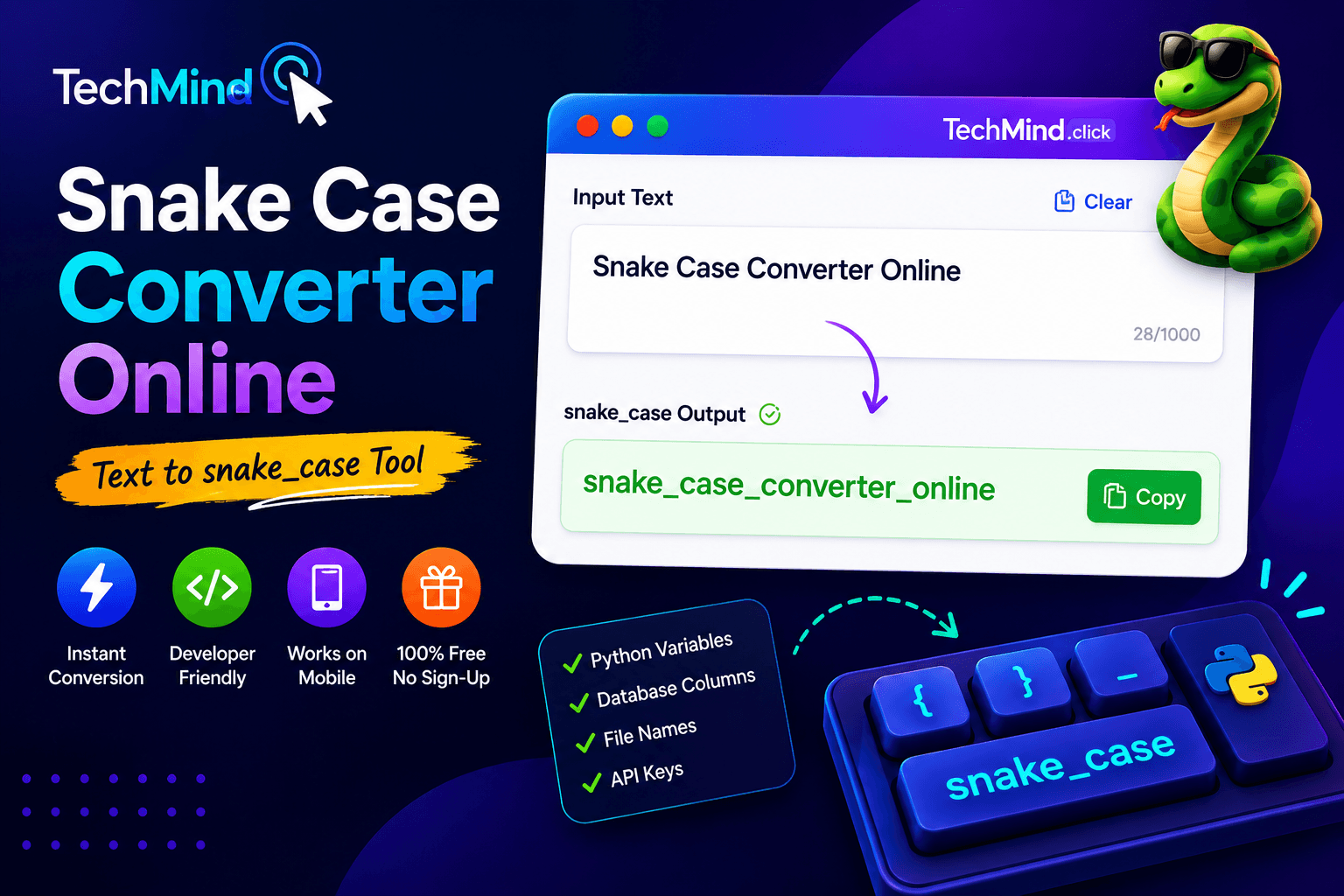
As Steve Jobs once said, "Details matter, it's worth waiting to get it right." In software development, naming conventions are exactly those details. A variable named UserFirstName in one file and user_first_name in another creates confusion, bugs, and maintenance headaches. snake_case is the standard that eliminates that inconsistency - and TechMind.click converts any text to snake_case in one click, free, without any sign-up.
What Is snake_case?
snake_case is a naming convention where words are written in all lowercase and separated by underscores. The name comes from the visual appearance - the underscores between words resemble a snake lying flat.
Example:
- Input: User First Name
- snake_case Output: user_first_name
snake_case is one of several naming conventions used in programming. Understanding when to use it - and when to use alternatives like camelCase or kebab-case - is a fundamental skill for any developer or technical writer.
snake_case vs Other Naming Conventions
| Convention | Example | Used In |
|---|---|---|
| snake_case | user_first_name | Python, Ruby, SQL, file names |
| camelCase | userFirstName | JavaScript, Java, TypeScript variables |
| PascalCase | UserFirstName | Class names, React components |
| kebab-case | user-first-name | URL slugs, CSS classes, HTML attributes |
| SCREAMING_SNAKE | USER_FIRST_NAME | Constants, environment variables |
As Albert Einstein observed, "If you can't explain it simply, you don't understand it well enough." The simple rule: use snake_case for Python and databases, camelCase for JavaScript variables, kebab-case for URLs. For URL slug generation specifically, our complete slug guide covers the kebab-case format in detail.
When Should You Use snake_case?
Python variables and functions:
Python's official style guide (PEP 8) recommends snake_case for variable names, function names, and module names. Writing Pythonic code means following this convention consistently - calculate_total_price() not calculateTotalPrice().
Database column names:
SQL databases - PostgreSQL, MySQL, SQLite - conventionally use snake_case for table and column names. first_name, created_at, user_id - this convention is so widely adopted that most ORM frameworks automatically convert camelCase model properties to snake_case database columns.
File and directory names:
For file systems - especially on Linux and macOS - snake_case is preferred over spaces (which require escaping in terminal) and over camelCase (which creates case-sensitivity issues). user_profile_image.png is safer than User Profile Image.png.
API response keys:
Many REST APIs - particularly those built with Python or Ruby - return JSON with snake_case keys. When you receive { "first_name": "John" } from a backend, it reflects snake_case naming from the server layer.
Environment variables and configuration:
Environment variables and config keys are often written in SCREAMING_SNAKE_CASE - the uppercase variant of snake_case. DATABASE_URL, API_SECRET_KEY, MAX_RETRY_COUNT - these are all snake_case in capitals. Understanding the lowercase conversion behind snake_case helps here.
How to Convert Text to snake_case Using TechMind.click
Winston Churchill said, "Success is not final, failure is not fatal: it is the courage to continue that counts." Converting naming conventions manually, letter by letter, is the kind of repetitive task that should never interrupt your flow. Here is how to do it instantly:
- Go to TechMind.click - The text formatter is on the homepage, ready immediately.
- Paste your text - Type or paste any text: a title, a phrase, a column name, a variable description.
- Click snake_case - Found in the Clean section of the toolbar. Your text converts instantly: spaces become underscores, all letters become lowercase, special characters are removed.
- Copy and use it - Click Copy Text and paste the snake_case output directly into your code, database schema, or config file.
Real examples:
- "User First Name" → user_first_name
- "Created At Timestamp" → created_at_timestamp
- "API Secret Key" → api_secret_key
- "Maximum Retry Count" → maximum_retry_count
- "Product Category ID" → product_category_id
Frequently Asked Questions
Q: What is the difference between snake_case and kebab-case?
snake_case uses underscores between words - user_first_name. kebab-case uses hyphens - user-first-name. They look similar but serve different contexts. snake_case is for code (Python, SQL, file names). kebab-case is for URLs, CSS classes, and HTML attributes. For URLs specifically, always use hyphens - Google treats hyphens as word separators but treats underscores as one combined word.
Q: Does snake_case work for JavaScript?
JavaScript conventionally uses camelCase for variables and functions - not snake_case. However, snake_case is acceptable in JavaScript for constants (though SCREAMING_SNAKE_CASE is more common) and when working with APIs that return snake_case JSON keys. The convention depends on your team's style guide.
Q: Can I convert camelCase to snake_case?
Yes. Paste your camelCase text into TechMind.click - the converter handles the transformation by splitting on capital letters, converting to lowercase, and joining with underscores. userFirstName becomes user_first_name.
Q: Is there a free snake_case converter that works without installation?
Yes. TechMind.click converts text to snake_case entirely in your browser - no installation, no sign-up, no character limit. Open the site, paste your text, click snake_case, copy the result.
Q: What happens to numbers and special characters in snake_case conversion?
Numbers are preserved in place. Special characters like !, @, #, &, and punctuation marks are removed. Spaces and hyphens become underscores. So "Product V2 Launch!" becomes product_v2_launch.
Q: Should database column names use snake_case or camelCase?
snake_case is the widely accepted convention for SQL database column names, particularly in PostgreSQL and MySQL. Most ORM frameworks (Django, SQLAlchemy, ActiveRecord) default to snake_case for database columns even when the application code uses camelCase. Using snake_case in your database ensures compatibility with standard tooling and avoids quoting requirements in SQL queries.
Final Thoughts
As APJ Abdul Kalam noted, "Excellence is a continuous process and not an accident." Consistent naming conventions are a form of that excellence - they make code readable, maintainable, and professional. TechMind.click makes applying those conventions effortless.
Try the free snake_case converter at TechMind.click - no sign-up, no character limit, works on any device.