Title Case vs Sentence Case - Which One Should You Use?
Admin
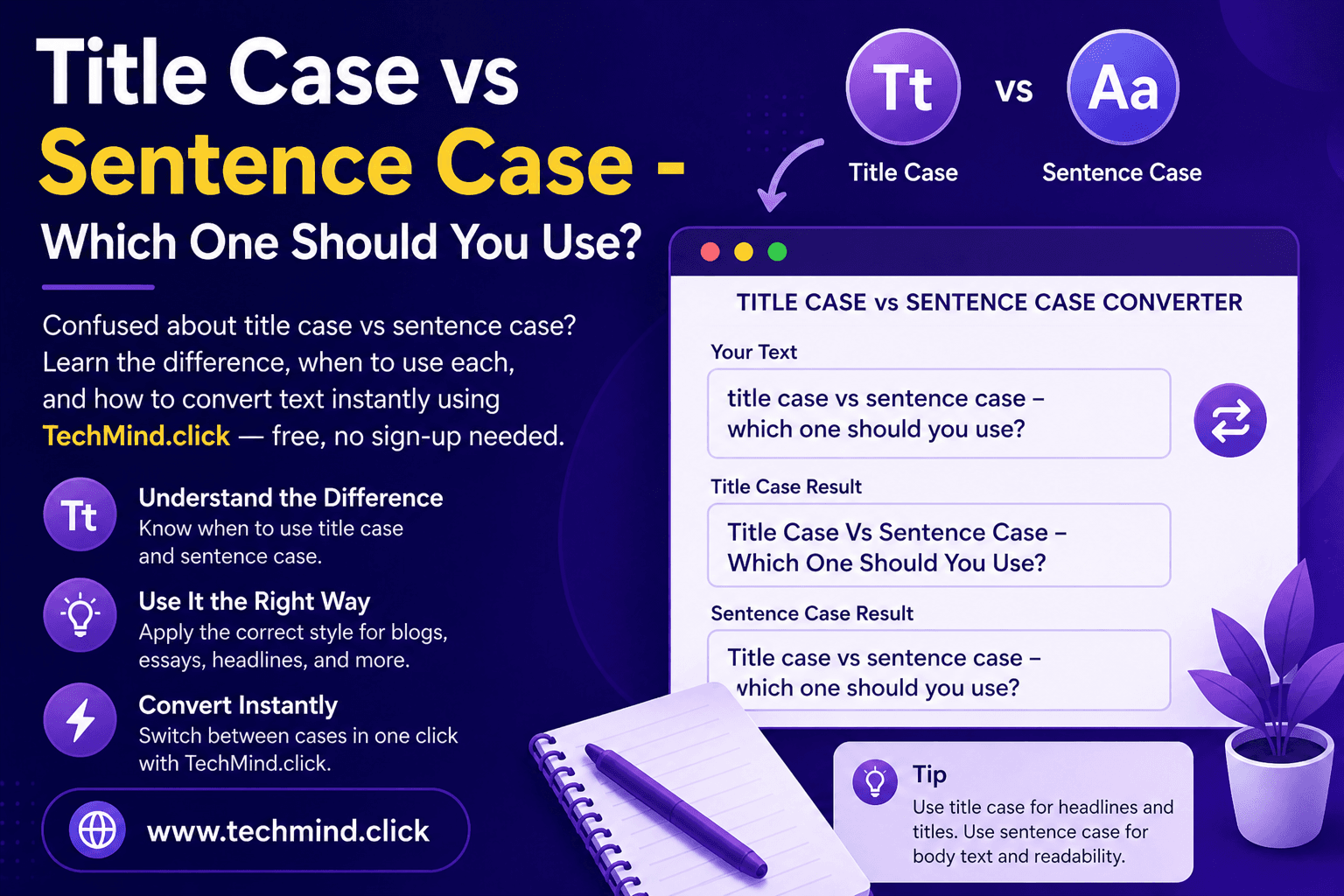
You are writing a blog post and you stop at the heading. Should it be "How To Write Better Headlines"? Or "How to write better headlines"? Both look reasonable. Both feel correct. But only one is right for your context - and getting it wrong affects how professional your content looks.
This is the title case vs sentence case debate, and it trips up writers, students, and content creators every single day. In this guide, we will break down both clearly, show you exactly when to use each one, and how to convert between them in seconds using TechMind.click. You may also want to read what is sentence case and how to convert text to uppercase for related guidance.
What Is Title Case?
Title case capitalizes the first letter of most words in a sentence. Smaller words like "a", "an", "the", "in", "on", "and", "but", and "or" are usually left lowercase unless they appear at the start.
Example:
- Title case: The Best Free Tools for Writers and Developers
Title case has a formal, authoritative feel. It signals importance and draws attention - which is why it has been used in newspapers, book covers, and official documents for centuries.
What Is Sentence Case?
Sentence case capitalizes only the first letter of the first word in a sentence, along with proper nouns. Everything else stays lowercase - exactly the way you would write a normal sentence.
Example:
- Sentence case: The best free tools for writers and developers
Sentence case feels natural, conversational, and easy to read. It is the default style for everyday writing - emails, messages, captions, and most modern web content.
Title Case vs Sentence Case - Side by Side
| Feature | Title Case | Sentence Case |
|---|---|---|
| Capitalization | Most words capitalized | Only first word + proper nouns |
| Tone | Formal, authoritative | Natural, conversational |
| Readability | Slightly harder to scan | Easier to read quickly |
| Best for | Books, news, formal docs | Blogs, emails, social media |
| Style guides | AP, Chicago, APA titles | Google, Apple, most SaaS |
When Should You Use Title Case?
Book and movie titles: This is where title case originated and where it still belongs. The Great Gatsby, How to Win Friends and Influence People, The Dark Knight - these are title case by convention.
News headlines: Most newspapers and news websites use title case for their headlines. It gives stories a sense of weight and importance.
Formal documents and reports: Legal documents, academic paper titles, business reports, and official correspondence typically use title case for headings and section titles.
Navigation menus: Many websites use title case for top-level navigation items - Home, About Us, Contact - because it looks clean and deliberate at a small size.
When Should You Use Sentence Case?
Blog posts and articles: Most modern blogs - including major publications like Medium, HubSpot, and Notion's blog - use sentence case for their subheadings. It reads more naturally and feels less stiff than title case.
Email subject lines: Sentence case in email subject lines performs better in A/B tests because it feels personal rather than promotional. Compare: "Limited Time Offer Ends Tonight" vs "Limited time offer ends tonight." The second one feels like it came from a real person.
Social media captions: Instagram, Twitter, and LinkedIn captions are almost always written in sentence case. Title case in a caption looks out of place and oddly formal.
UI and product copy: Google, Apple, Notion, and most major tech companies use sentence case for buttons, labels, tooltips, and interface text. It is cleaner and more accessible on screen.
Academic writing (body text): APA style uses sentence case for article titles in references. MLA and Chicago use title case for the works cited page but sentence case within body text headings at lower levels.
How to Convert Between Cases Using TechMind.click
If you have text that needs to switch from one case to another, doing it manually is slow and error-prone. TechMind.click converts instantly with one click:
- Go to TechMind.click - the formatter loads right on the homepage.
- Paste your text - any length, sentence or full paragraph.
- Click Title Case or Sentence Case - the text converts immediately.
- Copy and use it - done in under five seconds.
Both conversion options are available for free with no account required.
Which One Should You Pick?
Here is the simple rule: when in doubt, use sentence case.
Sentence case works everywhere - blogs, social media, emails, UI text, academic writing. Title case is a deliberate stylistic choice for specific formal contexts. If you are not writing a book title, a newspaper headline, or a formal document heading, sentence case is almost always the safer and more modern choice.
The most important thing is consistency. Pick one style and use it throughout your document or content. Mixed casing - some headings in title case, others in sentence case - looks careless even when each individual heading is correctly formatted.
Frequently Asked Questions
Does Google prefer title case or sentence case for SEO?
Google does not have a stated preference for either case style in headings or titles. What matters more for SEO is the keyword placement and the clarity of your headings. That said, sentence case tends to match how people type search queries, so it can feel more natural in page titles and meta descriptions.
Can I mix title case and sentence case in the same document?
Technically yes, but it looks inconsistent and unprofessional. The best practice is to choose one style and apply it to all headings of the same level throughout your document. For example: all H2 headings in sentence case, all H3 headings in sentence case.
Is there a fast way to check which case my text is in?
Yes - paste your text into TechMind.click and try clicking both Title Case and Sentence Case. You will immediately see how your text looks in each format, making it easy to decide which one fits your content. It is free and works without any sign-up.
Final Thoughts
Title case and sentence case are both correct - they are just meant for different situations. Title case belongs in formal, published, and traditional contexts. Sentence case belongs in modern, conversational, and digital content.
Now that you know the difference, you will never second-guess your headings again. And when you need to convert your text quickly, TechMind.click has both options ready - free, instant, and no sign-up needed.